Who it is for
Spoken English decides who gets hired
SEAP (Spoken English Assessment and Practice) is for students at Industrial Training Institutes, the government vocational schools for trades such as electrician or fitter, and at polytechnics and degree colleges. They are 18 to 35, and most grew up speaking a regional language. Their courses teach English on paper, and no instructor has time to hear each student speak.
When about 3,970 pilot learners joined, we asked them why. 73.6% said placements and job interviews, and two thirds rated their own speaking at the lowest two of four levels. The answers that shaped the product were about habit: 26.5% had already tried an English app and stopped, and 64.8% had never used one. A product that only scored them would lose them too. The hard problem was getting learners to come back.
Key decisions
I counted learners who came back, not sign-ups
A supervised session in a computer lab can produce hundreds of registrations in an hour. It cannot produce a learner who returns the next day on their own. On 27 April 2026, before the first institute went live, I wrote the pilot design around one success metric, Reached. The two calls after it followed from what the pilot showed.
Count a return, not a registration
- The call
- A learner counts as Reached only after three or more assessments, at least one a day or more after joining. An assessment is one scored attempt: reading a passage aloud and getting each word checked.
- What I gave up
- A large headline number. Registrations were reported, but never counted as success.
- Why
- Registrations measure how well a lab session is run. A return measures whether the product earned a second visit. For 2.0, part of the fees paid to implementation partners, the organizations that signed up institutes and ran sessions, was tied to Reached, so they were paid for learners who came back.
Evidence · The target was written into the pilot design before launch. The results table shows how the pilot did against it.
Replace open practice with a 25-lesson path
- The call
- In 2.0, learners follow 25 lessons in order, from the basics to being ready for an interview, centered on speaking and making sentences.
- What I gave up
- Clean before-and-after measurement. Learners on a path are harder to compare with the pilot's open practice.
- Why
- In 1.0, learners picked passages in random order with no rising difficulty, and most did not come back enough to count. 2.0 was planned from November 2025; the pilot data refocused it on coming back and on making sentences.
Ship 2.0 as a web app
- The call
- Build 2.0 as a progressive web app: a web link that opens in the phone's browser and can be added to the home screen, with nothing to download from an app store.
- What I gave up
- Native notifications, the most reliable tool for bringing learners back.
- Why
- A web app is far simpler to roll out across institutes and to plug into national platforms. We designed the habit loop around weaker notifications instead, with WhatsApp nudges next on the list.
Results
1,772 learners came back; the top quarter practiced hard
5,868 learners registered and 4,578 took part, meaning they did at least one assessment. Every pilot share on this page uses the 4,578 who took part as its base; the two surveys state their own.
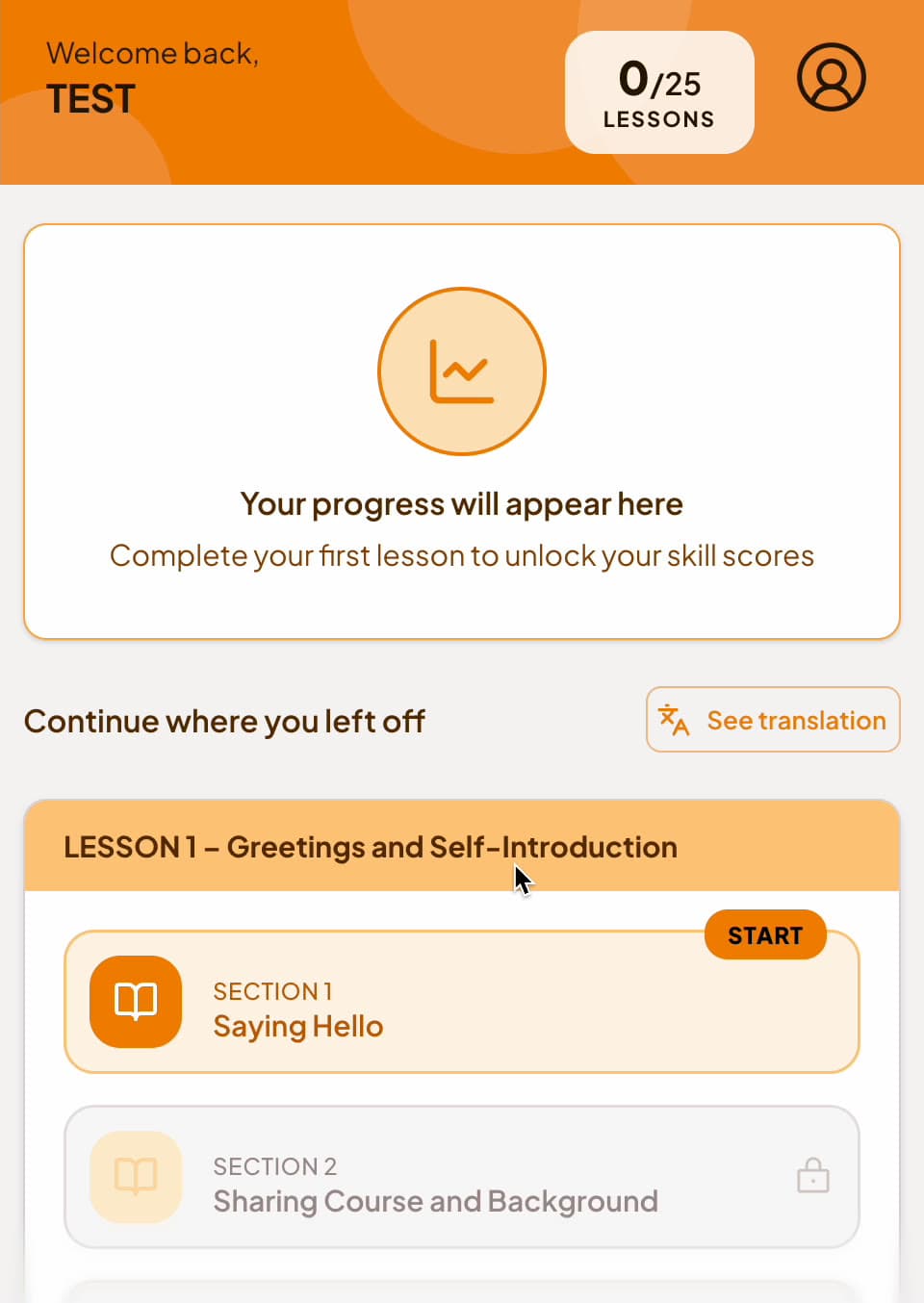
Without being asked, about 2,000 learners, 44%, read a passage they had already done a second time. On the retry, their median speed rose from 87.6 to 94.6 words read correctly a minute. It showed what makes these learners practice: seeing their own score rise.
The average hides two groups. Across 91,375 assessments, the average learner did about 20 (my arithmetic). The top quarter of users did about 60 each. Most learners, given passages in random order, did not return enough to count. That is the problem 2.0's ordered path was built for.
Exhibit 1
49 institutes against 18 planned, and 1,772 learners Reached
| Measure | Result | Status |
|---|---|---|
| Institutes (18 planned) | 49 | Exceeded |
| Learners Reached (5,000 set in advance) | 1,772 of 4,578 (39%) | Next fix |
| Retried a passage unprompted | About 2,000 (44%) | Measured |
| Median speed, first read to retry | 87.6 to 94.6 words a minute | Measured |
| Felt more confident, end-of-pilot survey | 78% of 537 who chose to answer | Self-report |
| 2.0's Reached rate, against the pilot's 39% | The next test, below | To test next |
One field problem threatened the metric. When the dashboard showed zero Reached for learners who had returned more than a day later, we traced it to duplicate names. A metric that reads zero while learners practice teaches everyone to ignore it.
What 2.0 changed
Learners found making sentences hardest, so 2.0 centers on speaking
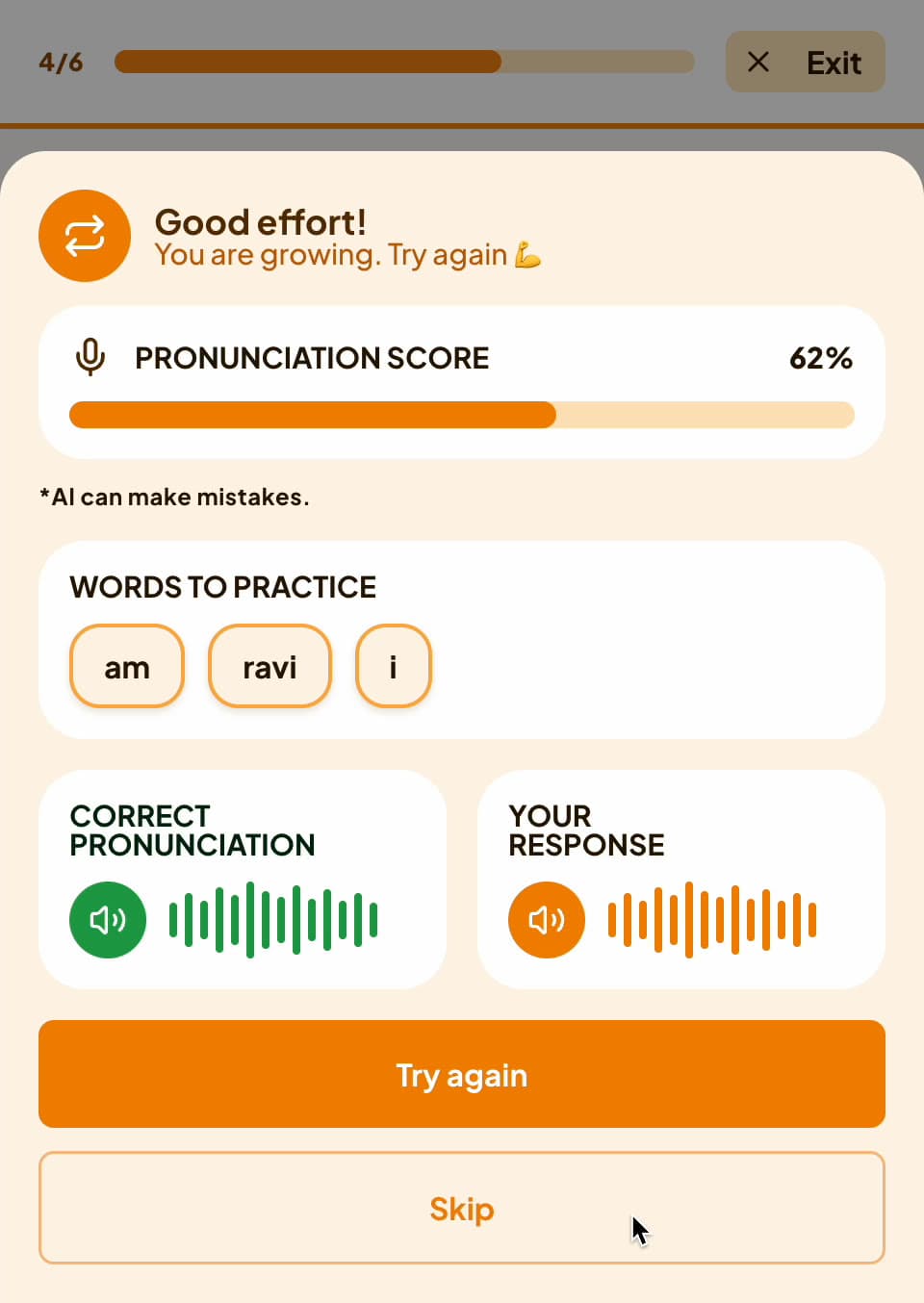
1.0 practiced one thing, reading aloud, because it was easy to score with the speech model we had. A speech model turns speech into text; SEAP lines that text up against the expected words and marks each one right, wrong, missed or extra. The baseline survey pointed 2.0 at a different target.
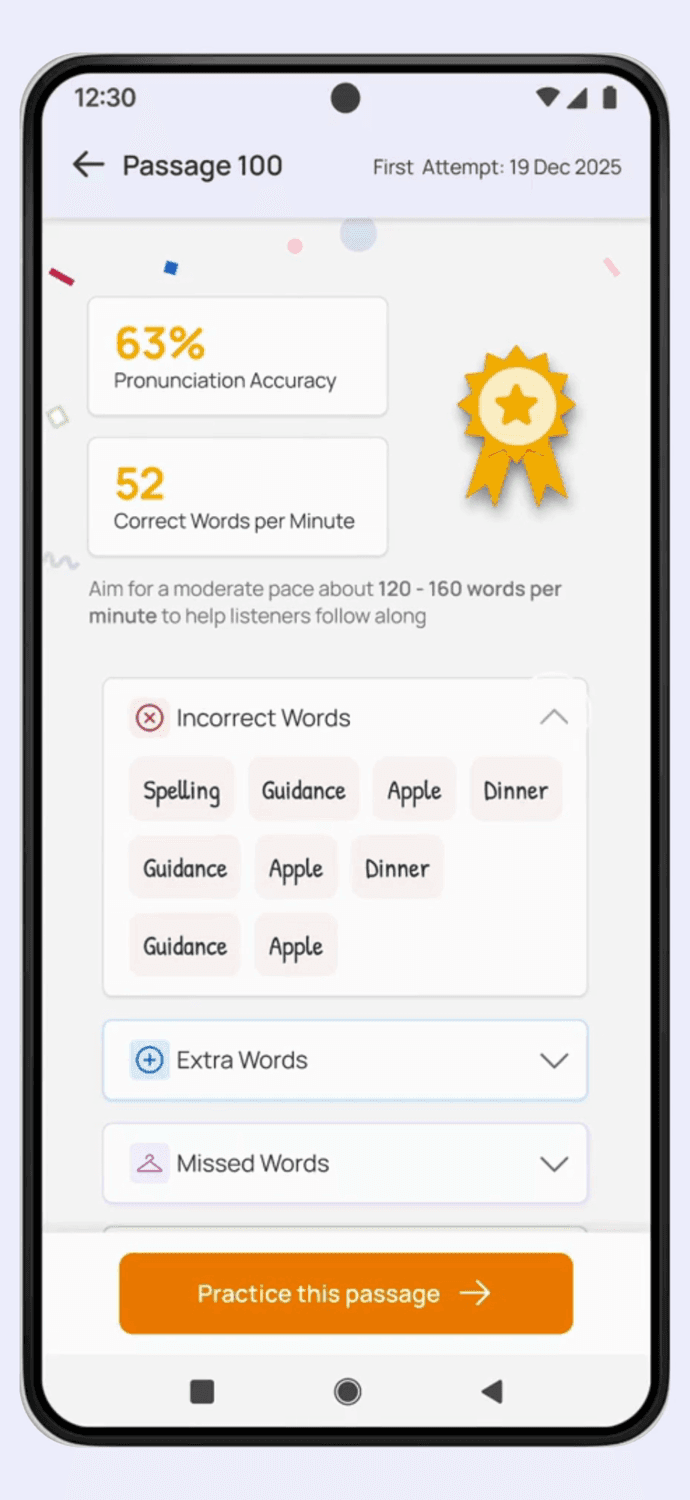
11.0: read a passage aloud and see every word marked, then practice it again.
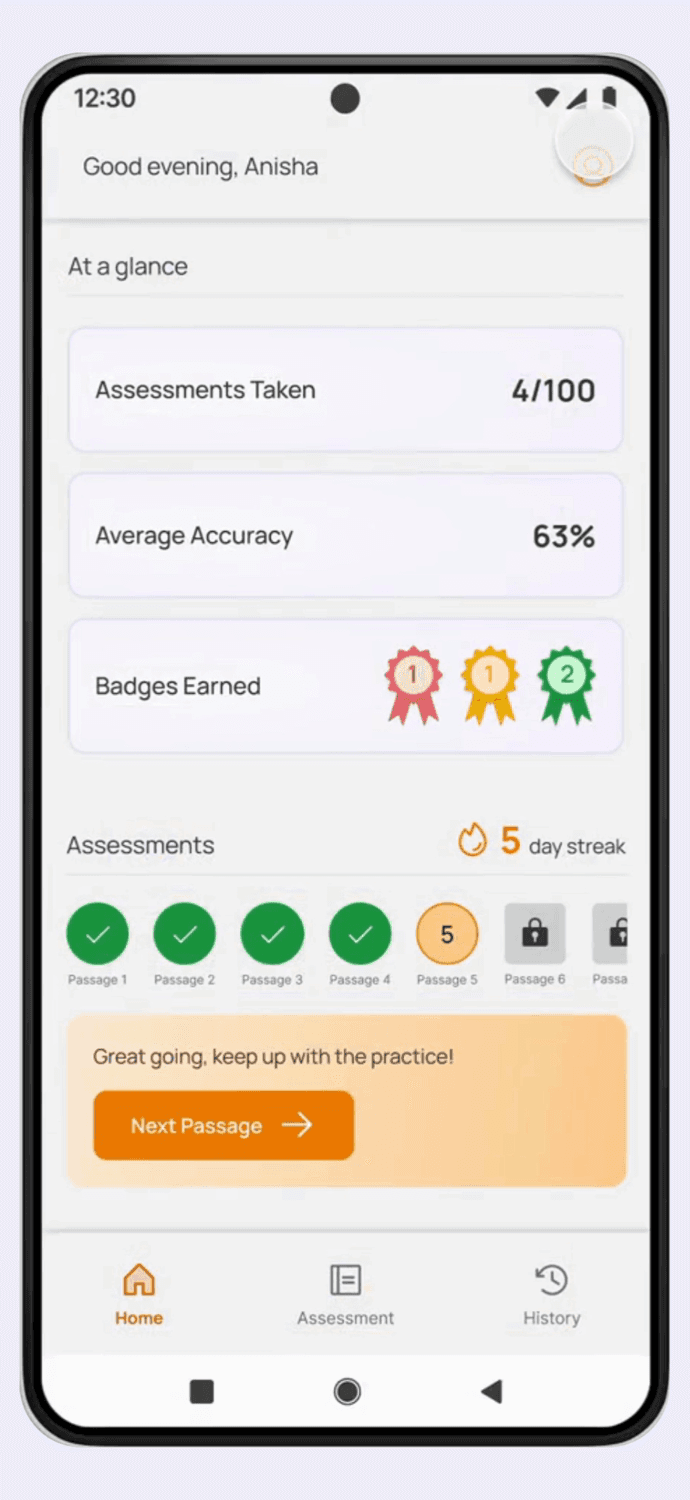
21.0 home: assessments taken, badges and a daily streak.
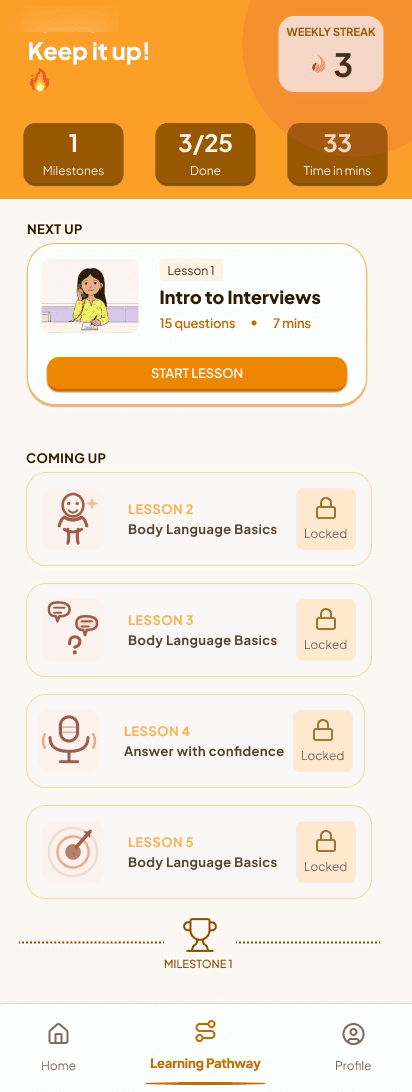
32.0 design: a weekly streak and a 25-lesson path, one lesson unlocking the next.
Exhibit 2
Reading aloud, the only thing 1.0 practiced, came last
- Making sentences43.7%
- Grammar when speaking42.5%
- Confidence in front of others37.2%
- Pronunciation31.0%
- Reading aloud without pausing9.7%
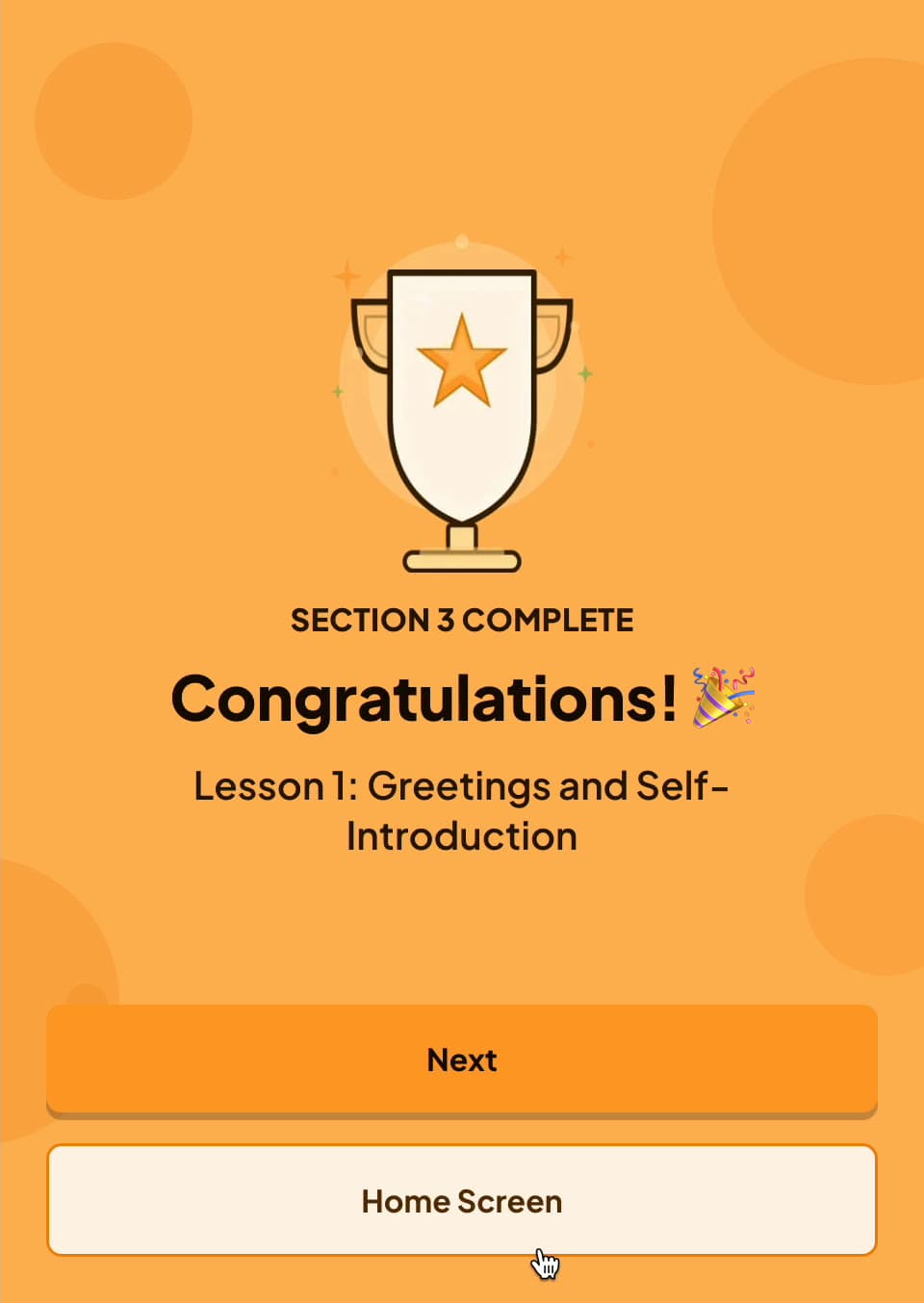
So 2.0 puts speaking and listening first, with grammar and vocabulary exercises in support, set in workplace and interview scenes. Instructions come in regional languages, to explain the task, not to translate the English. A learner who answers wrong must see the right answer and why before moving on, because skipping without feedback turns practice into clicking. The live 2.0 screens are at the top of this page.
- 01
A nudge to come back, with WhatsApp next on the list
- 02
A lesson: listen, speak, tap
- 03
Feedback, with the right answer and why
- 04
Streak, badge and skill profile update
- 05
A progress report to learner and institute
The decision in July was to go ahead, and 2.0 began deploying on 23 July 2026, days before I handed over. I also designed one of India's largest English speech datasets for SEAP, more than 5,000 hours from every state, and the speech model fine-tuned on it is 50% more accurate. The pilot's scores came from the base model.
Ownership
I owned strategy and metrics, with final say on scope
My part was strategy and measurement. I narrowed the target to vocational and college learners, for whom spoken English is a hiring filter. In November 2025 I planned two versions: a cheap 1.0 pilot on the existing speech model and 2.0, the product. I wrote the pilot design and the Reached metric, and in May 2026 the metrics framework for the July decision on scaling 2.0: five pass-or-fail gates and seven critical-path metrics, each with a pass mark written down before the data came in. Scope and flows were decided in a product, pedagogy and design forum where I had the final say. With the designer I wrote the research guide, ran scoping workshops, visited learners after 1.0 went live and tested 2.0 prototypes with them.
I worked through a product manager, who owned the specs and the day-to-day work with engineering. Engineers built the app, ML scientists trained the speech model, pedagogy experts and I defined the levels, and implementation partners onboarded institutes and ran sessions. I designed the flow of the app used to collect accent data; another engineering team built it.
To fill One call where you and the product manager or engineering disagreed: what each side wanted, how it was settled, and what happenedNext test
The first test I would run on 2.0
I designed this test before handover. One question was open at handover: should the leaderboard rank learners by percent correct, or by points earned, so that a retry adds points instead of dragging a score down?
- Hypothesis. Ranking by points earned will raise the share of learners who come back, because pilot learners retried when they could see a score rise.
- Change. Control: the leaderboard ranks by percent correct. Variant: it ranks by points earned. Classmates compare ranks, so I would assign whole institutes to one version, not single learners.
- Primary metric. Reached within 14 days of joining: the pilot's rule with a fixed window, so both arms get equal time. The pilot's rate was 39%; the control arm gives 2.0's own baseline.
- Guardrail. First-attempt score on lessons a learner has not yet seen. If points reward farming easy retries, this falls.
- Sample and duration. To fill The smallest rise in Reached worth shipping, and 2.0's weekly sign-ups per institute. For scale, my arithmetic: detecting a rise from 39% to 44%, with 80% power at the usual 5% significance level, needs about 1,500 learners per arm, before the extra needed because institutes, not learners, are assigned. It runs until both arms reach that size and each learner has had 14 days.
- Decision rule. If Reached rises by at least the agreed amount and the guardrail does not fall by more than To fill the agreed margin, ship points to every institute. If Reached rises but first-attempt scores fall, keep points but cap them per passage. If Reached does not move, keep percent correct.
Sources: SEAP 1.0 pilot design, 27 Apr 2026; SEAP 1.0 metrics framework, May 2026; baseline survey, May 2026; field issues log, May to June 2026; SEAP decks, June and July 2026; handover facts sheet and notes, July 2026.