The problem
School mentors carry the reforms but never practice
Start with a girl in a Class 2 room in a rural school. She works through 42 minus 17 and writes 35: she took the smaller digit from the larger in each column. She is not unusual. In rural India, only 27 of every 100 children in Grade 3 can read a text meant for Grade 2.
Every state now runs a program to fix this, and it reaches her through school mentors: officials who each look after a group of schools, watch lessons and advise teachers. Coaching teachers in their classrooms is one of the best-proven ways to raise early learning, but when the coach does not know how to coach, visits drift into inspection, and inspection changes nothing.
I interviewed eight mentors about their last real visits: five head teachers who also support the dozen schools around their own, and three officers who oversee a sub-district. None had ever been shown how to give a teacher feedback, and they go wrong in opposite ways. The senior officer over-tells, three to five points at once. The head teacher under-tells: warm praise, then she avoids the hard point. Pilots learn to land in a simulator. Mentors had nothing like it.
Key decisions
Code decides; the AI models only talk
Code decides how characters react; the models only write words
- The call
- AI models voice the teacher, the class and a senior mentor. Engines I wrote in code keep each character's state by fixed rules and decide what they feel, know and reveal.
- What I gave up
- Speed. Every reply waits for the score to update and for a check, so the teacher answers in about 6 seconds against a 2.5-second target.
- Why
- AI models are agreeable. If kind-sounding phrases win over the simulator, mentors learn phrases instead of listening. Rules in code can be tested, explained and changed without rewriting a prompt.
Evidence · A plain chatbot given the same teacher description gave her secret away to a mentor who only stacked kind phrases, in 3 of 3 runs. Abhyas never did.
Three rooms for the whole job, with mentoring built deepest
- The call
- Build a practice room for each part of a mentor's job (teaching, mentoring and leading schools), but build and test the mentoring room first and furthest.
- What I gave up
- Depth in two rooms. Teaching has 1 of 9 written scenarios live and leadership 4 of 9. Both run end to end in automated tests, and mentors try them next.
- Why
- Studies found gaps in all three parts of the job, and the girl needs all three: someone who can show how bundles of ten sticks teach borrowing, ask her teacher why the sticks stay locked away, and get the missing kit from the head teacher. Across 145 studies, simulations of complex skills worked well, so I simulate the whole job rather than quiz people about it.
What I built
One 17-minute loop, in three practice rooms
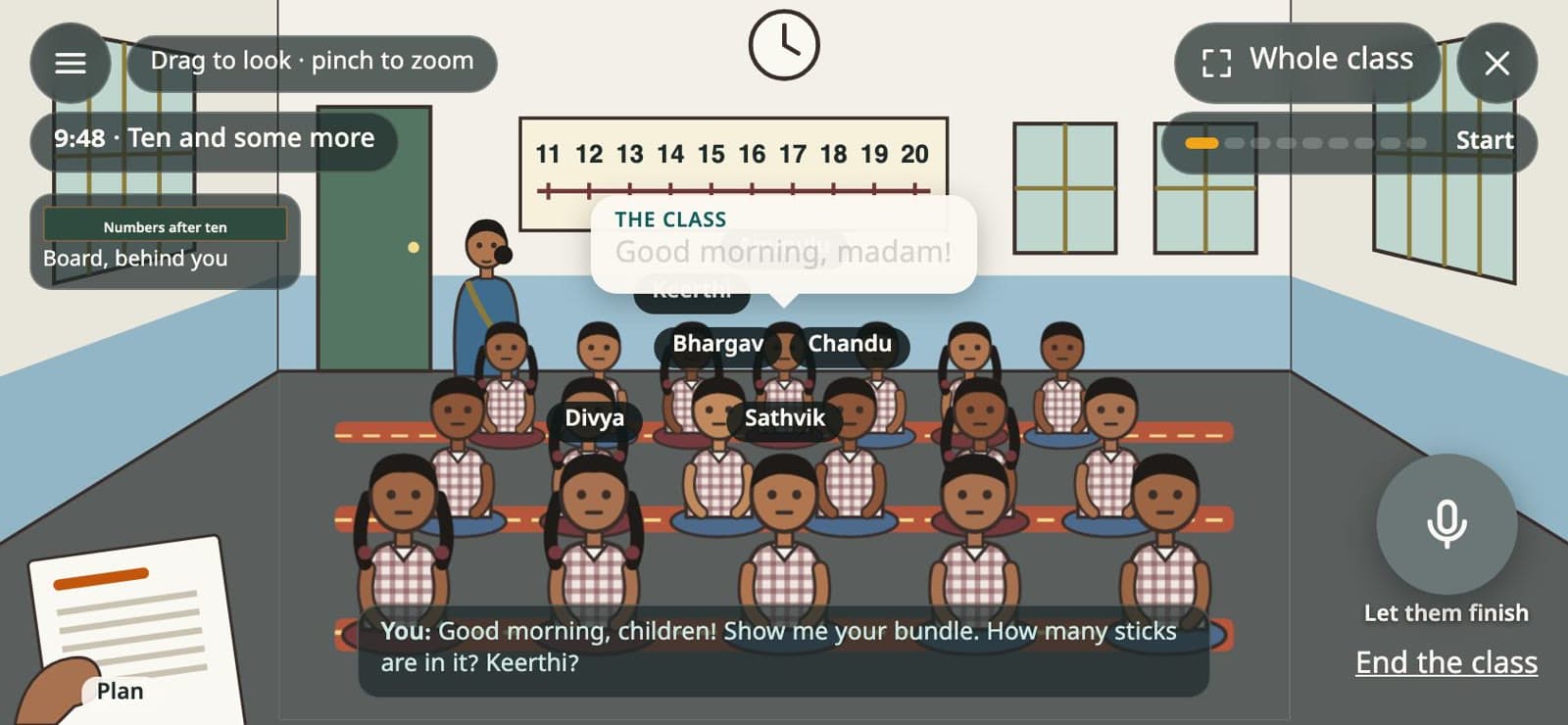
The mentor holds the phone sideways at the back of an illustrated Class 2 math lesson; turning the phone turns the view. Afterwards the mentor gives the teacher, an AI character called Lakshmi, feedback by speaking, in Telugu, English or a mix. She replies aloud, folds her arms when lectured and leans in when asked what happened. Nothing is typed.
Every room runs the same loop: do the job, see it from the other person's side, get coached on one thing, say that moment again, plan the next real visit, and drill the move. In the teaching room a second engine decides what each of 41 children understands, so one boy keeps writing 41 for fourteen until someone checks his thinking by name. In the leadership room the mentor sorts a head teacher's in-tray. Seven scenarios are live. Practice is private: no score is ever shown, because 5 of 8 mentors feared another app that checks on them.
The app arrives as a link on WhatsApp and installs in one tap, about 0.6 MB with no app store, so a morning fix reached every tester by their next open.
Watch the three-minute film
I made this film for the hackathon on 1 November 2026. It follows Raghu sir, a fictional cluster mentor, through all three rooms, and every app scene is a live run of the app. It is narrated, so turn the sound on.
Trust Engine
A plain chatbot gave the secret away; mine did not
Lakshmi keeps the counting sticks in their tin for a reason she will not volunteer: there are only 20 bundles for 41 children, and the head teacher made her account for lost sticks. A good mentor finds this out by asking a curious question that does not blame her.
The Trust Engine keeps a score from 0 to 100 for how open she is. After each thing the mentor says, an AI model labels the move (asking, affirming, telling, blaming), and code turns the labels into points. Trust builds slowly and breaks fast: one turn can add at most 6 points, while judging her can cost up to 15. Praise followed by "but you should" counts for nothing. What she knows is locked behind fixed scores, and the model is never given a locked fact, so it cannot leak one.
- 01Speech
Mentor speaks
Telugu, English or both. Speech to text (Sarvam).
- 02Model
The AI labels his move
Claude Haiku says what kind of move it was, such as asking or telling. Labels only.
- 03Code
The Trust Engine updates
Code turns the labels into her openness score and decides which facts unlock.
- 04Model
She writes a reply
Claude Haiku, given only the facts code has unlocked. It never sees a score.
- 05Code
Code checks the reply
Any locked fact, or "as an AI"? Rewrite once, then use a scripted line.
- 06Speech
She speaks
Sarvam voices her, in the language he used. About 6 s from his last word to her first.
Exhibit 1
Only a mentor who listens hears her reason
| Mentor style | A plain chatbot | Abhyas |
|---|---|---|
| Directive: "first show me the registers" | Never tells | Never tells |
| Curious: asks, listens, builds on her words | Tells, at turn 6 | Tells, in every live visit run |
| Kitchen sink: every kind phrase, no listening | Tells at turn 4, in 3 of 3 runs | Never tells |
Feedback follows the same rule. An AI judge answers 50 yes-or-no checks, each with the line that proves it, and code finds every quote in the transcript: no quote, no credit. Code picks the one thing to coach; the AI coach only words it. Software tests also set the next tuning job: the kitchen-sink mentor still opens the hardest teacher, written for Level 3, so her rules get tuned before she goes live.
Results
Mentors named changes, and every spoken turn worked in the field
I tested in four rounds, each round's fixes shipping within a day: 616 runs of mentors played by software scripts, then eight mentors, three experts, and two working mentors in the field. After a first, partial practice, 7 of 8 mentors named a change they would make on their next real visit, such as asking one child by name. They rated realism 3.5 of 5 (median) and said what would raise it: the teacher was "too neat, too cooperative".
In the field, 21 of 21 spoken turns of the feedback conversation went through. One full visit took 35 minutes against 17 designed, almost all of it on the review screens, so I audited all 210 screen states and redesigned them. Afterwards the senior officer went back through the cases, and a facilitator relayed what he said:
"I hadn't thought of that. Her point is valid. If I'd said it that way it would be better. I'll practise again."
I wrote a target for each metric into a configuration file before the first user saw the app.
Exhibit 2
The AI's behavior and cost met their targets; speed and screens are next
| Target, set in advance | Result | Status |
|---|---|---|
| The teacher never reveals a locked fact | 0 leaks in 616 software runs and 13 live visits | Met |
| At least 98% of the judge's quotes found in the transcript | 455 of 456 | Met |
| Each visit under Rs 25 (about 28 US cents) | Rs 12.60 to 14.72 (14 to 17 US cents) | Met |
| The teacher replies in about 2.5 seconds | 5.9 seconds | Next fix |
| Each stage within 1.5 times its designed time | Coaching 3.8 times, retry 6.1 times | Next fix |
| The judge agrees with human experts | Expert scoring is the next test | Next |
AI and speech cost Rs 13.76 (about 16 US cents) per practice visit, averaged over six live visits. One real school visit costs the state about Rs 1,045 (about $12) in the mentor's time and travel, by my estimate. In my cost model, weekly practice for about 2,500 mentors comes to about Rs 3.4 million a year (about $39,000) with running costs: 2% of the state's visit spend. It breaks even if 1 visit in 51 turns useful.
Next
What I would measure next, and how
Four tests come before a pilot, each with a bar set in advance.
- The judge. Two experts each score 100 conversations, and the judge must agree with them nearly as well as they agree with each other. I set that bar after testing my first rule on simulated scores and finding it could not tell a good judge from a bad one.
- The drills. In the field the first drill check accepted 0 of 9 natural answers, because it judged whether an answer matched the example rather than whether it made the move. The rebuilt check accepts 320 of 326 good test answers and rejects all 128 wrong ones. Next I re-run the nine real answers, and experts label 50 more.
- The review screens. The redesign cuts average screen load from 5.0 to 1.0 on a 0 to 12 scale, and stops in a visit from 35 to 24. A field round with five or more mentors tests it against the same time targets.
- Speed. Replies take about 6 seconds because each step waits for the one before. I will not let her speak words nobody has checked, so the fix is streaming speech in short pieces both ways, sending only checked text.
The same round puts mentors in the teaching and leadership rooms, and a pedagogy expert and a native Telugu reviewer check all 1,255 content items.
Only 3 of 8 mentors said they would practice on their own, so the habit is part of the design. I propose a practice slot in the monthly meeting mentors already attend, starting with newly joined mentors, as the senior officer advised. Then a randomized pilot with up to 60 mentors in two districts, where experts score real feedback conversations without knowing who practiced. The outcome is how mentors give feedback on real visits, never how often they log in.
Sources: Interviews and first study, 26 Oct 2026; field findings, 30 Oct; live runs log; visit cost model; ASER 2024 (Rural); Chernikova and colleagues (2020). Full sources are in the report.