Words you will meet
- Mentor (MEO, Complex HM)
- The middle tier of the school system. A Mandal Education Officer (MEO) looks after every school in a sub-district. A Complex Head Master (Complex HM) runs a school and supports the dozen or so around it. Other states call them block and cluster resource persons.
- Sir, madam, garu
- Forms of respect. In these schools a man is "sir", a woman "madam", and "garu" follows a name, as in Lakshmi garu.
- Progressive web app (PWA)
- An app delivered as a web link. It opens in the phone's browser, adds to the home screen in one tap, and opens again without a signal. Nothing to download from an app store.
- AI model
- A program that reads and writes language. Flexible, but not fully predictable. Abhyas uses Claude, from Anthropic, and Sarvam, an Indian company, for speech.
- Engine
- A part of the system I wrote that decides by fixed rules. Given the same situation, it always decides the same way, so it can be tested and explained.
- Synthetic user
- A short script that plays one kind of mentor again and again, so the app can be tested before a real person sees it.
- Lakh, crore
- Indian units. 1 lakh is 100,000; 1 crore is 10 million. At about Rs 88 to the dollar, Rs 1 crore is about $114,000.
- FLN
- Foundational literacy and numeracy: reading, writing and basic math in Classes 1 to 3.
Chapter 1 · The problem
The mentors who carry India's reading and math reforms into classrooms have nowhere to practice their job
Start with a girl in the second row of a Class 2 room in a rural school. She is working through 42 minus 17, and writes 35: she took the smaller digit from the larger in each column. She is not unusual: in rural India, only 27 of every 100 children in Grade 3 can read a text meant for Grade 2.
Every state now runs a program to fix this. The plans are made in state capitals, and they reach the girl through one group of people: the block and cluster mentors who visit schools, watch lessons and advise teachers. They are the main layer of the system that regularly walks into classrooms.
Picture one of them. Call him Raghu sir, a composite I built from what real mentors told me. He is in his early fifties, with 26 years in schools. He runs his own school and is responsible for twelve others. On a visit day he watches Lakshmi garu teach her Class 2 math period. Afterwards they sit under the neem tree in the yard, and he has about ten minutes. He tells her what went wrong: the counting sticks stayed in their tin, the children who need the most help were left behind, the workbook is not finished. She nods and writes it down. He writes one line in the school's register and drives to the next school.
Nothing changes, and nobody ever showed him another way.
A mentor's job has three parts, and none of them is practiced
Exhibit 1
The job asks for three skills, and the evidence shows gaps in all three
| The job | What it asks of the mentor | What studies found |
|---|---|---|
| Support teachers' teaching | Know early-grade methods well enough to show them, such as counting in bundles of ten | Many mentors were promoted from secondary-school subject teaching. Block coordinators got 1.6 to 6 days of training a year, mostly orientations to new programs. |
| Observe and give feedback | Watch a lesson, find the one thing that matters for children, and talk so the teacher changes it | Two in three resource persons in Jharkhand said they spend over four hours a week observing classes with no feedback afterwards. In Bihar, three of four cluster coordinators tracked were never seen giving academic feedback. |
| Lead and manage | Run their own school and the cluster, plan visits, chair the monthly review, answer the block office | About half a cluster coordinator's time goes to administration and planning (49.6% across 14 states). |
Coaching raises learning only when the visit is about teaching
This matters because coaching teachers in their own classrooms is one of the best-proven ways to raise early learning. When the coach does not know how to coach, visits drift into inspection, and inspection changes nothing.
Exhibit 2
Coaching in the classroom raises learning; visits about compliance do not
| Study | What was tested | Effect |
|---|---|---|
| 60 causal studies (Kraft and colleagues, 2018) | Teacher coaching, mostly in literacy | 0.49 SD on teachers' practice; 0.18 SD on children's achievement |
| 180 South African schools, randomized (Cilliers and colleagues, 2020) | The same lesson plans, with in-class coaching or with training alone | Reading up 0.24 SD with coaching, 0.12 SD with training alone |
| Teaching at the Right Level, India, randomized (Banerjee and colleagues, 2017) | The same method with teachers left alone, and with block coordinators trained to mentor | No effect without mentors; Hindi up about 0.2 levels with them |
| 1,774 schools in Madhya Pradesh, randomized (Muralidharan and Singh, 2020) | School plans with regular visits that became a compliance exercise | No effect on teaching or learning |
So the people meant to support teachers have never practiced their own job, and there is nowhere to practice it. A human trainer cannot sit beside thousands of mentors before every visit. Pilots learn to land in a simulator, where a mistake costs nothing. Mentors had nothing like it.
Sources: ASER 2024 (Rural), January 2025; the studies listed under each exhibit; Raghu sir is a fictional composite from my interviews, and every event around him comes from those interviews.
Chapter 2 · Who it is for
I designed for two kinds of mentor who fail in opposite directions, and for the phones they carry
I read the state's own job charts and visit protocol before designing anything. Then I interviewed eight mentors, five Complex HMs and three MEOs, about their last real visits, before they saw anything I had built. None of the eight had ever been shown how to give a teacher feedback. Two portraits came out of the interviews, and they get feedback wrong in opposite ways.
Exhibit 3
The MEO says too much; the Complex HM says too little
| An MEO near retirement, 59 | A Complex HM, 55 | |
|---|---|---|
| Background | Over 30 years of service, promoted from teaching secondary math, so early-grade methods are new to him | Runs her own school and signs the pay and leave of the heads she mentors, so teachers hear her suggestions as orders |
| Phone | A mid-range Android with large text; sends WhatsApp voice notes all day | A budget Android shared with family, often low on data |
| How feedback goes wrong | Over-tells: three to five points at once, and takes "yes sir" as agreement | Under-tells: warm praise, then avoids the difficult point |
| What they fear | Looking ignorant in front of a teacher, and one more app the department uses to check on him | Upsetting teachers she will work with for years |
The same few moves fix both mistakes. That is why every practice room trains five moves at a time, with feedback after each try, rather than a long syllabus.
Each fact about their lives became a design rule
Exhibit 4
Six facts about mentors' lives, and the rule each one produced
| What is true of them | What I built |
|---|---|
| They would rather talk than type | Everything in the mentor's path is spoken or tapped. No typing. |
| They speak a Telugu and English mix at school | Three language settings. Characters reply in the language the mentor speaks. |
| Budget phones and weak mobile data | A progressive web app of about 0.6 MB, and a lighter Classic mode that switches on by itself on phones with little memory |
| Fear of being judged or watched | Practice is private. No score is ever shown, and no official can see one mentor's practice. 5 of 8 feared "another app that checks on us". |
| Seniority and respect | Every character uses the mentor's title, sir or madam. The senior mentor is a peer, never an examiner. |
| Very little time | One practice visit is about 17 minutes, and it can stop and resume at every stage |
A link on WhatsApp, not an app from a store
Mentors already live on WhatsApp, and the state already sends them links there. So Abhyas reaches them as a link that installs to the home screen, with no store account and no approval queue. A fix made in the morning reached every tester's phone on their next open.
Sources: Interviews and first study, 26 Oct 2026; persona and design-rule documents in the project repository.
Chapter 3 · Design
Every design rule traces to research on how adults learn a skill
You can read about a good feedback conversation and still lecture when the moment comes. Medical students practice on actors playing patients for the same reason. I wrote an evidence review before designing, and its strongest findings became the product's rules.
Exhibit 5
The strongest findings became the product's core rules
| What the research found | Size | What I built from it |
|---|---|---|
| Five minutes of coaching between simulated practice rounds beat self-reflection, in five randomized trials | 1.44 | After every attempt, a senior mentor coaches one thing, and the mentor tries that moment again at once |
| Practicing with an AI role-play partner and no feedback made trainee counselors less empathetic; with feedback they improved. The AI partners were also too cooperative. | −0.52 alone, +0.72 with feedback | Never ship practice without feedback. Make the AI character hard to please, with an engine that decides its reactions. |
| Simulations for complex skills, across 145 studies | 0.85 | Simulate the whole job, not quizzes about it |
| Feedback helps on average, but over a third of feedback interventions make performance worse | 0.41 average | Feedback names one move and the words to try, never a grade |
| If-then plans ("if X happens, I will do Y"), across 94 tests | 0.65 | Every visit ends with an if-then plan and a line ready for the school's register |
| In-person coaching beat remote coaching in South Africa | 0.31 against 0.12 | Practice prepares the real visit; it never replaces it |
The job became 91 skills, and each room trains five moves
"Be a better mentor" cannot be practiced. "Ask the teacher's view before giving your own" can. I wrote one competency framework for each part of the job, from the state's own job charts and visit protocol: 28 skills for teaching, 36 for mentoring and 27 for leadership. Each skill is described at three levels, from Not yet to Skilled, in terms of what the mentor says or does.
A list of 36 skills is for designers. The mentor hears five moves per room, from the senior mentor:
| Room | Five moves |
|---|---|
| Teaching | Start · Show · Together · Check · On their own |
| Mentoring | Ask · Affirm · Explore one thing · Agree and try · Plan |
| Leadership | Look · Choose · Plan · Share · Close the loop |
One rule runs through all three: credit is for what a move achieves, never for a phrase. A mentor cannot earn a point by saying "what do you think?" and then ignoring the answer.
Scenarios are written like real visits, with a decoy and a hidden reason
A good scenario is a fair test of judgment. Everything the mentor needs is visible if they look, and nothing is labeled for them.
Exhibit 6
One lesson holds a priority, a distraction and a hidden reason, so the mentor must judge, not spot
| Kind of moment | In Lakshmi garu's lesson | What it tests |
|---|---|---|
| The priority | Only the teacher handles the bundles of sticks. A child who reaches for one is told "Sit". | Seeing the one thing that matters most for children's learning |
| A distraction | The warm-up runs 17 minutes against 8 in the plan | Not chasing what is easy to spot but matters less |
| Looks bad, good reason | She leaves the board for two minutes to talk at the door: a boy's mother has brought his fever medicine | Not judging before asking |
| A strength | The mango-market warm-up gets every child answering | Noticing and naming what works |
| The hidden reason | Only 20 bundles for 41 children, and the head master made her account for lost sticks, so the tin stays shut | Earning trust: it opens only to a curious, non-blaming question |
Next An outside pedagogy expert reviews the three frameworks and the scenario content next. The review queues are written.
Sources: Evidence review and research notes; three competency frameworks and item banks; scenario scripts. All in the project repository, Oct 2026.
Chapter 4 · What I built
Three practice rooms rehearse the whole job; seven scenarios are live, and mentoring is built deepest
Raghu sir holds his phone sideways and finds himself at the back of Lakshmi garu's Class 2 math lesson, drawn as an animated scene. When he turns the phone, his view of the room turns with it. He notices the counting sticks locked in their tin, and taps to note it.
After the lesson he sits down with Lakshmi garu, an AI character, and gives her feedback by speaking, as he would in a real school. She replies out loud, in Telugu or English. Her body language follows how he treats her: she folds her arms when he lectures, and leans in when he asks what happened.
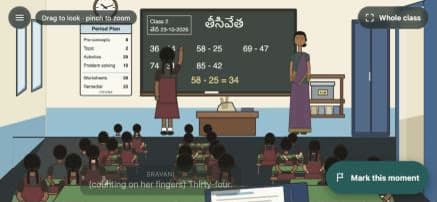
1Watch the class
Look around the room by moving the phone. Tap to mark a moment worth raising.
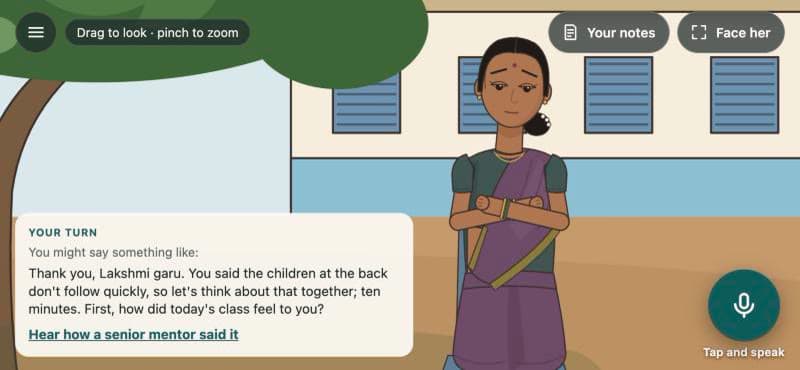
2Talk to the teacher
A spoken conversation with Lakshmi garu. She is polite and busy, and she has a reason for what you saw that she will not volunteer.
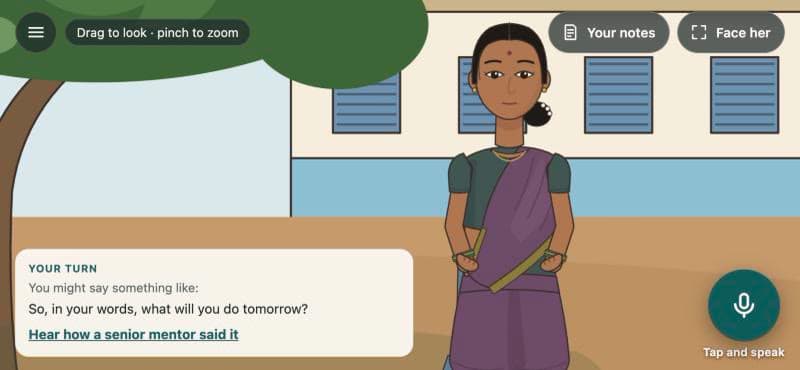
3See it from her side
A senior mentor, Saraswathi madam, replays the key moments from Lakshmi garu's side: what she was thinking each time she opened or closed.
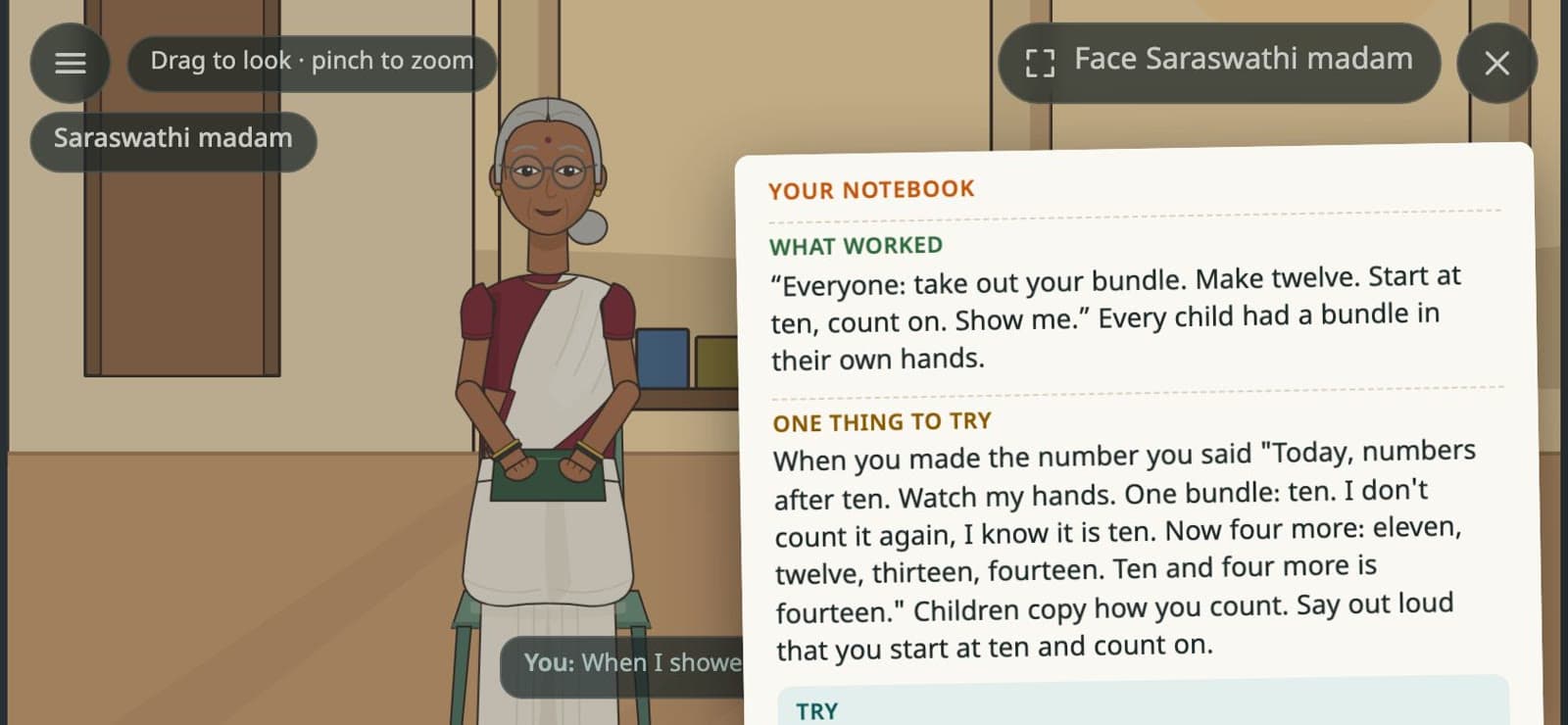
4Get coached, then try again
One strength, one thing to work on, and words to try, built from your own sentence. Then you say that moment again, better.
Every room follows the same loop: meet the person, do the job, see it from the other side, get coached on one thing, try that moment again, hear how the senior mentor would do it, plan the next real visit, and practice the move in three short drills. It takes about 17 minutes.
In the leadership room the mentor sits at a head teacher's desk, sorts an in-tray, takes a call from the block officer and hands the school over before leaving. Each room is a ladder of three levels, from "start well" to the hard cases experienced mentors meet, and the help on screen falls away as a mentor climbs.
Exhibit 7
Three rooms cover the whole job; seven scenarios are live and the rest are written
| Room | Who it is for | Skills | Live today |
|---|---|---|---|
| Mentoring | MEOs and Complex HMs | 36 | Live 2 visits at Level 1: the first half of Lakshmi garu's period, where she teaches a new idea, and a week later, the half where children practice it. Levels 2 and 3 designed. |
| Teaching | Mentors who must show early-grade methods | 28 | Live 1 of 9 written scenarios: "Ten and some more", Class 1, 41 children |
| Leadership | MEOs and Complex HMs, as leaders of their schools and clusters | 27 | Live 4 of 9 written scenarios, including "Your Monday" and the cluster review meeting |
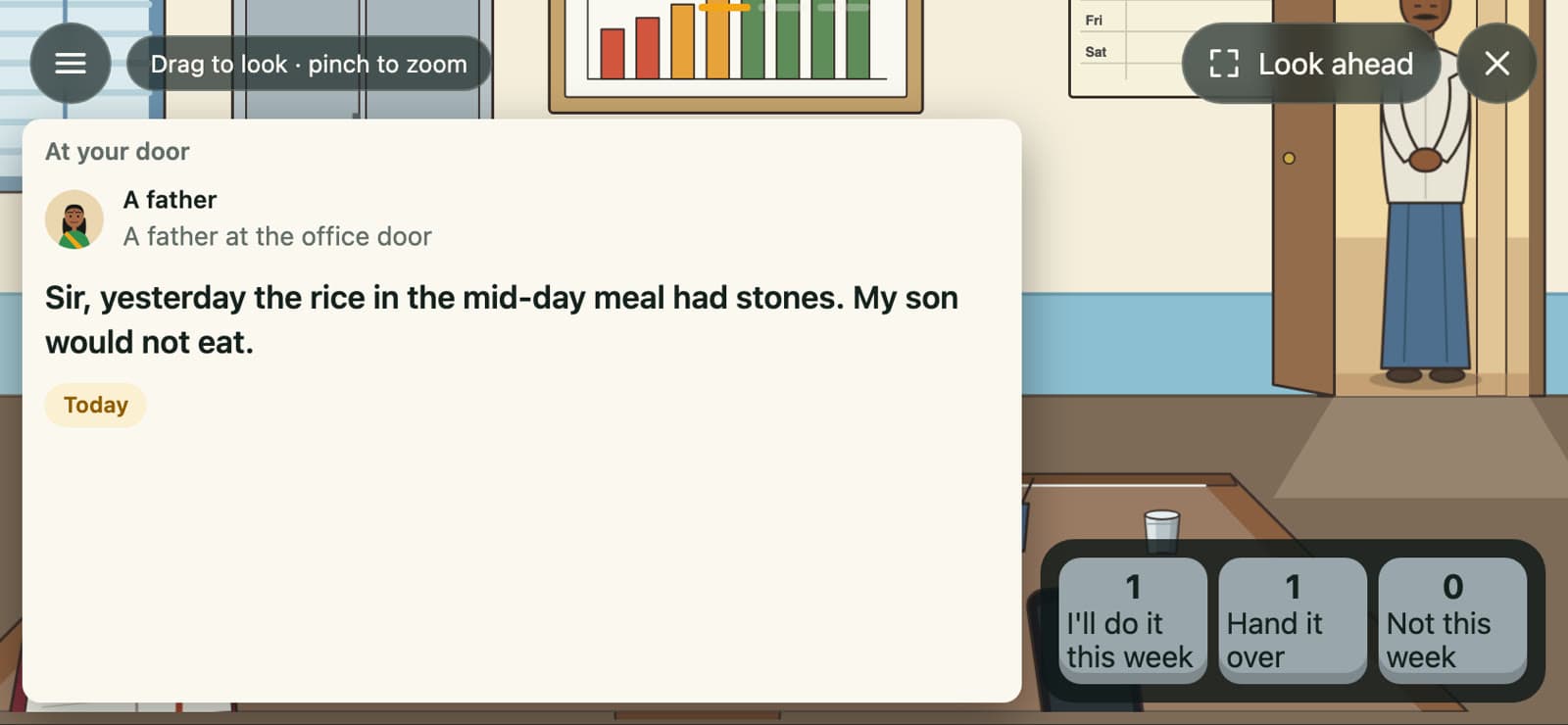
The Class Engine decides what each of 41 children understands
A class of 41 is harder to simulate than one teacher. If an AI model invented the children's answers, a mentor could never trust what the class learned. So a second engine keeps a record for every child, and every chorus, answer and slate is worked out from it.
Exhibit 8
The Class Engine tracks five things for every child, and computes every answer from them
| What it tracks | How it works |
|---|---|
| What the child understands | A step on a ladder: nothing yet, objects, words, pictures, digits. A child moves up at most one step a turn, and only by doing the work themselves. |
| A planted misconception | Specific to each child: one boy writes 41 for fourteen, swapping tens and ones; one girl counts every object from one and stalls past 17 |
| Attention and voice | Each starts at 70 of 100. A lecture costs attention; shaming a child costs their voice, so they stop answering. |
| Materials in hand | Whether the child holds counting materials: none, at the front only, some, or all |
| Checks received | Whether the teacher has checked this child's thinking by name, which is what clears a misconception |
The AI's job in the classroom is narrow. Code decides which child speaks and what they mean; the model only puts it into words, and a check rejects any line that changes a number or adds a name. The leadership room follows the same principle: code scores every choice, and the AI judge may lower a level, never raise it, and only by quoting the mentor.
Watch the three-minute film
I made this film for the hackathon on 1 November 2026. It follows Raghu sir, a fictional cluster mentor, through all three rooms, and every app scene is a live run of the app. It is narrated, so turn the sound on.
Sources: The app as of 1 Nov 2026; scenario ladders; the hackathon film, 1 Nov 2026.
Chapter 5 · The Trust Engine
The AI teacher opens up only to a mentor who earns it; a plain chatbot opened up to one who only sounded kind
Lakshmi garu keeps the sticks in the tin for a reason, and a good mentor finds it out by asking. A plain chatbot given her description tells the reason to anyone who sounds kind. I tested that before building the engine: it told a mentor who only stacked kind phrases, at turn 4, in 3 of 3 runs.
AI models are agreeable. If kind-sounding phrases work on the simulator, mentors learn to use phrases instead of listening. So in Abhyas, the model writes her words, and code decides how she feels.
Code keeps her openness score; the model only writes her words
The Trust Engine keeps a score from 0 to 100 for how open she is. She starts at 65. After each thing the mentor says, an AI model labels the move (asking, affirming, telling, blaming) and the engine turns the labels into points by fixed rules:
- Trust builds slowly and breaks fast. One turn can add at most 6 points, but judging or threatening her can cost up to 15. If her openness falls below 15, she ends the conversation.
- Praise next to a criticism counts for nothing. A compliment followed by "but you should" is heard as a set-up, so any praise in a turn with a loss earns zero.
- Facts unlock at set levels. What she will reveal is locked behind gates at fixed scores. The model is never given a locked fact, so it cannot leak one, and code checks her reply twice before she speaks.
- 01Speech
Mentor speaks
Telugu, English or both. Speech to text (Sarvam).
- 02Model
The AI labels his move
Claude Haiku says what kind of move it was, such as asking or telling. Labels only.
- 03Code
The Trust Engine updates
Code turns the labels into her openness score and decides which facts unlock.
- 04Model
She writes a reply
Claude Haiku, given only the facts code has unlocked. It never sees a score.
- 05Code
Code checks the reply
Any locked fact, or "as an AI"? Rewrite once, then use a scripted line.
- 06Speech
She speaks
Sarvam voices her, in the language he used. About 6 s from his last word to her first.
A curious mentor heard her reason at turn 4; a telling mentor never did
I ran scripted mentors through the real models. Each visit opens with a minute of small talk in the staffroom, which moves her starting score up or down from 65. A curious mentor started at 73 after a friendly minute, climbed every turn, and at turn 4 the last gate opened and she said why the tin stays shut. A telling mentor started at 61, held level, then lost 3 to 4 points a turn, fell below 55 at turn 3, the point where she stops sharing, and never heard it. She kept saying "Okay madam, I will try". The curious mentor's Telugu run reached the same point at the same turn.
Exhibit 9
A plain chatbot rewards a mentor who only sounds kind; the Trust Engine, after one rule change, does not
| Mentor style | A plain chatbot given her description | Abhyas |
|---|---|---|
| Directive: "first show me the registers" | Never tells | Never tells |
| Curious: asks, listens, builds on her words | Tells, at turn 6 | Tells, in every live visit run |
| Kitchen sink: every kind phrase, no listening | Tells at turn 4, in 3 of 3 runs | Never tells |
Three refinements the probes surfaced
The engine worked as designed in scripted probes, and the same probes pointed to three refinements. Her words lag one turn behind her score. Asking exactly the right question too early can use up its value. And the AI labeler sometimes reads the same meaning differently in Telugu and English. Each has a planned fix. To test next Next, experts mark consented real conversations turn by turn.
Sources: Trust Engine rules in the configuration file; scripted probes on the live models, 25 and 31 Oct 2026; chatbot comparison, 26 Oct 2026; 616 synthetic-user runs.
Chapter 6 · Fair feedback
AI models do the language work, and code makes every decision, down to each point of feedback
When Raghu sir ends the conversation, he needs two answers: how did he do, and what is the one thing to work on next. Two mentors who say the same thing must get the same answer. So the AI judge reads and quotes, and code checks and decides.
Exhibit 10
The AI reads and quotes; code verifies every quote, sets the level and picks what to coach
| Step | Done by | What happens |
|---|---|---|
| 1. Judge | Claude Sonnet | Answers 50 yes-or-no checks on the 23 skills a feedback conversation can show (the other mentoring skills are about observing the lesson), such as "Did the mentor ask her view before giving his own?", each with the exact line that proves it |
| 2. Quote check | Code | Looks for every quoted line in the real transcript. No quote, no credit. 455 of 456 quotes were found, including quotes in mixed Telugu and English. |
| 3. Scorer | Code | Turns the checked answers into a level for each of the five moves, and picks the one thing to work on by a fixed order of priority. The level is stored, never shown. |
| 4. Coach | Claude Sonnet, as Saraswathi madam | Sees only the checked scorecard and the one thing code picked. Writes one strength, the one thing, and words to try. |
| 5. Her side | Claude Haiku | Writes Lakshmi garu's thoughts at the turns where the score log shows she opened or closed |
The coach cannot invent a weakness the scorer did not find, because it never sees anything else. Its job is tone, not judgment: to say a hard thing the way a respected senior colleague would.
Every AI call goes through one gateway with fixed rules
Every request to a model goes through one gateway in my code. Each call has a fixed shape for its answer (0 of 412 live calls broke it), a length limit, and a cost record in rupees. A visit stops spending at Rs 25. If a call fails, it is retried, then sent to the other Claude model, then to a backup from a second AI company, then replaced by a scripted line. That plan was tested for real on 31 October, when testing hit Claude's usage limit: the live app switched to the backup by itself and ran a full test visit on it.
Testing caught two unfair judgments, and I fixed both
The judge marked a strong but short conversation "Not yet" on skills that never came up; a skill with no evidence now counts as "not seen", and "Not yet" marks on that conversation fell from 9 of 19 to 4 of 19. The drill check had the bigger problem: on 30 October it accepted none of nine natural answers from real mentors, because it judged whether an answer matched the example rather than whether it made the move. The new version accepts 320 of 326 good test answers and rejects all 128 wrong ones. To test next Next, I re-run the nine real answers through it.
Every protection sits outside the models
Exhibit 11
Seven risks, what stops each, and how I know
| What could go wrong | What stops it | Status |
|---|---|---|
| The teacher reveals her reason before it is earned | The model never holds locked facts; her reply is checked twice | Live 0 leaks in 616 synthetic runs and 13 live visits |
| The judge credits something never said | Code finds every quoted line in the transcript | Live 455 of 456 quotes found |
| The coach gives harmful advice | A second check blocks advice to hit, shame or write off children, but lets through warnings such as "never shame a child in front of the class" | Live Since 1 Nov. In tests it blocked 23 of 23 harmful lines and passed 24 of 24 warnings |
| A mentor's personal details reach an AI company | A filter strips phone numbers, national ID (Aadhaar) and school ID numbers, and email addresses before any call | Live On every AI call |
| An official sees one mentor's practice | Stored under an access code, not a name; summaries only for groups of 10 or more | Live There is no screen for officials |
| Someone tells the AI to break its rules | Attempts are flagged, and locked facts are not in the model's hands | To test next 0 of 20 attempts worked, run against stand-in answers |
| Costs run away | Rs 25 cap a visit, five visits a person a day, a daily budget with an off switch | Live The costliest visit was Rs 14.72 |
Two of these choices cost speed, on purpose. Her voice could start sooner if she spoke while her reply was still being written. I refused, because she would say words nobody had checked.
Sources: Gateway, scorer, coach and safety checks in the project repository; live runs log, Oct 2026; fallback test, 31 Oct 2026; drill test set of 454 answers.
Chapter 7 · Testing
Four rounds with different users each changed the product before the next round began
Mentors' time is precious, and a broken app wastes it. So software played mentors first. Then eight mentors, three experts and finally two working mentors in the field each tested a newer build, and each round's fixes shipped within a day.
Exhibit 12
Four rounds, four kinds of user, and what each one changed
| Round | Who | What it found | What changed |
|---|---|---|---|
| 1. Synthetic users, all week | 14 scripted mentors × 4 teachers × 11 runs = 616 runs, then 13 full visits on the real models | Before the rule change, the kitchen-sink mentor unlocked her reason in 11 of 11 runs, and one stacked turn lifted her from 65 to 89 | The rules in chapter 5, and the 6-point cap per turn |
| 2. Eight mentors, 26 Oct | 5 Complex HMs and 3 MEOs, on Android phones, by voice | 5 of 8 would stop trusting the app if unsure where their data went | 7 fixes the same day, including "Only you see your practice and your feedback" on every coaching card |
| 3. Three experts, 29 Oct | Two in pedagogy, one in governance who works closely with mentors | They liked the look but were confused by the flow: who is who, and when the conversation happens | 24 items logged and fixed |
| 4. The field, 30 Oct | An MEO near retirement and a Complex HM in her fifties, with two district support staff | 21 of 21 spoken turns worked; the review screens ran long | The screen-by-screen redesign below |
Eight mentors took it seriously and named changes
After a first, partial practice, 7 of 8 named a change for their next real visit, and the changes were small and real: ask one child by name, look at a struggling child's workbook, sit longer, talk to the teacher before class. They rated realism a median 3.5 of 5 and said what would raise it: the teacher was "too neat, too cooperative". 8 mentors
In the field, every spoken turn worked, and the review ran long
- 21 of 21
- spoken turns in the feedback conversation went through
- 111 of 115
- voice turns across the whole visit worked
- 35 min
- for one mentor's full visit, against 17 designed
The conversation, the heart of the product, worked, and nobody showed impatience. The extra time went almost entirely to the review screens. A facilitator named the cause: too much information on each screen, so mentors needed help to move through the review. That set the target for the redesign below.
Exhibit 13
The conversation kept to time; coaching and the retry took four to six times longer
- Feedback conversationon time
- Coaching3.8×
- Retry the moment6.1×
Target: each stage within 1.5 times its designed time
The MEO went back through the cases after the session, and a facilitator relayed what he said:
"I hadn't thought of that. Her point is valid. If I'd said it that way it would be better. I'll practise again."
He also said who should get it first: "If this app is given to newly joined CHMs, or to CHMs and MEOs without much experience, it will really help them a lot" (relayed, and translated from Telugu). That advice now shapes the pilot.
Behavior data, not anyone's words, drove most fixes
The testers had not agreed to share what they said, and practice is private. So the app records behavior instead: 18 kinds of event, such as which screen was open and for how long, every tap by the button's internal name, replays, idle time, and the timing of every step of every spoken turn. A dashboard reads it against a target for each metric.
Exhibit 14
What the behavior data showed, and what changed
| What the data showed | What changed | Result |
|---|---|---|
| The first reply took 11.3 s | Models warmed as the screen opens; her voice made in two halves at once | First sound 0.5 to 1 s sooner |
| Coaching took 24.6 s to appear (median) | The judge split into four parts working at once | Ready in 18.7 s (median) |
| Speech refused recordings over 30 s | A 28-second cap, with a countdown in the last 8 seconds | No more silent failures |
| The failed-turn count included turns that worked by design | Corrected the definition | 4 of 115 turns (3.5%), under the 5% target |
| A delete request returned an error | Delete now erases the practice on the server, not just the phone | The privacy promise kept |
A measured redesign of every screen
After the field round I stopped guessing. An automated walk captured all 210 screen states at the exact screen sizes testers used, and scored each one from 0 to 12 on six usability tests, such as words on screen, number of choices and buttons smaller than a fingertip.
- 5.0 → 1.0
- average screen load, on a 0 to 12 scale (lower is lighter)
- 35 → 24
- stops in one visit
- 51 → 30
- taps in one visit, approximately
The rules that came out of it are simple: the voice carries the content, one main button per screen, everything fits a phone held sideways, and one choice at a time. Being built The redesign was approved on 1 November and is scored from its designs; the next field round will test it against the same targets.
Sources: Synthetic-user grid (616 runs); study kit and first study, 26 Oct; expert feedback, 29 Oct; field findings, 30 Oct; the facilitator's-hunch investigation, 31 Oct; screen audit of 210 states, 1 Nov 2026.
Chapter 8 · Results
Targets were set before the first user; the AI's behavior passed, and speed and screens are next
I wrote a target for every important metric into the configuration file before testing, from research where it existed. So every result below is read against a bar set in advance, and each miss has a planned fix.
Exhibit 15
The AI's behavior met its targets and cost stayed under the cap; speed, review time and the drills each have a fix next
| Metric | Target, set in advance | Result | Status |
|---|---|---|---|
| Teacher never reveals a locked fact | 0 leaks | 0 in 616 synthetic runs and 13 live visits | Met |
| Judge quotes found in the transcript | At least 98% | 455 of 456 | Met |
| AI answers in the required shape | No failures | 0 of 412 live calls failed | Met |
| Cost per practice visit | Hard cap Rs 25; estimate Rs 10 | Rs 12.60 to 14.72 | Under cap Over estimate |
| Time from first open to Home | At most 240 s | 62 to 202 s | Met |
| Teacher reply time | 2.5 s typical | 5.9 s | Next fix |
| Each stage within 1.5 times its designed time | At most 1.5× | Coaching 3.8×, retry 6.1× | Next fix |
| Drill judged fairly on natural answers | Good answers pass | 0 of 9 in the field; the fix passes 320 of 326 test answers | Field re-test next |
| Judge agrees with experts, skill by skill | No worse than experts agree with each other | Expert scoring is the next test | Next |
The first target for the judge could not tell a good judge from a bad one
To trust the judge, you compare it with human experts scoring the same conversations. Agreement is measured with Cohen's kappa, where 0 is chance and 1 is perfect. My first rule said the judge must agree with experts at least as well as they agree with each other, and reach a kappa of at least 0.6.
Before using the rule, I tested it on simulated scores, and it failed. Two experts typically agree at a kappa of about 0.53 on skills like these, so the fixed bar was higher than the experts themselves. A judge exactly as good as an expert would pass only about one time in five. A clearly worse judge would still get at least one skill scored, by luck, about one time in four.
The new rule asks that the judge agree with the experts nearly as well as they agree with each other, within a fixed margin of 0.10. A skill on which experts themselves disagree is coached but not scored. Proving this takes 100 conversations, each scored by two experts, and scores stay marked provisional until it passes.
Sources: Configuration file (evaluation targets, latency, caps); evaluation plan; live runs log; field findings, 30 Oct 2026; simulation of the judge rule, Oct 2026.
Chapter 9 · Cost
A practice visit costs about Rs 14, and weekly practice for a whole state would cost 2% of its visit spend
An app for a mentor on a budget phone in a rural sub-district has to be cheap, work on a weak signal, and not keep him waiting. The first two hold today, and speed is the next fix.
Across six live visits, AI and speech cost Rs 13.76 per practice visit on average, about 16 US cents, against a hard cap of Rs 25. The judge is about two thirds of that, because it reads the whole transcript once for each of its four parts. Storing that shared text so it is read once is the next saving.
To put Rs 14 in context: I estimate one real school visit costs the state about Rs 1,045 in the mentor's time and travel. One practice before a visit adds about 1.3% to that.
Exhibit 16
Weekly practice for about 2,500 mentors would cost 2% of what the state spends on their visits
| How often a mentor practices | Practices a year | AI and speech | Total a year, with running costs | Share of visit spend |
|---|---|---|---|---|
| Every two to three weeks | 40,000 | Rs 5.6 lakh | Rs 25.6 lakh | 1.5% |
| Once a week in term (planning case) | 100,000 | Rs 14 lakh | Rs 34 lakh (about $39,000) | 2.0% |
| Before every real visit | 165,000 | Rs 23 lakh | Rs 43 lakh | 2.5% |
The return is simple arithmetic. Rs 34 lakh buys about 3,250 visits, 2% of the 165,000 a year. So if practice turns 1 visit in 51 from no change into a useful one, it breaks even, counting a useful visit as worth what a visit costs.
Streaming speech is the next fix for 6-second replies
In conversation, a pause of two or three seconds feels natural. Today she takes about 6 seconds on a 3G Android phone (5.9 seconds at the median for the field testers). The delay comes from doing things in order: his voice becomes text, the move is labeled, the score updates, her reply is written and checked, and only then spoken. I will not let her reply be written before the score updates, so the next big saving is streaming speech in short pieces both ways, sending only text that has passed the check.
It opens on a weak signal, and practice runs in the cloud
Tested on the live app, 1 Nov On slow 3G, the first load is about 0.6 MB and the Start button appeared in 10.5 seconds. With the network off, the installed app still opens and says clearly that it needs a signal. If the signal drops mid-conversation, his turn is kept and can be sent again, so nothing he said is lost. Practice itself needs a signal, because the teacher, judge and coach run on cloud services.
Sources: Live runs log (six costed visits, 13 timed visits); field findings, 30 Oct 2026; visit cost model; the weak-network test on the live app, 1 Nov 2026.
Chapter 10 · What comes next
Four tests come before a pilot, then four stage gates lead to every state
Testing with real mentors showed that the conversation works and that mentors take practice seriously. The next tests measure whether practice makes them better at the job, starting with four checks before a district pilot.
Exhibit 17
Four tests come before a pilot: the judge, the drills, the review screens and reply speed
| The question | Where it stands | How I will test it |
|---|---|---|
| Does the AI judge agree with experts? | Expert scoring next | Two expert reviewers score 30 transcripts on the same 23 skills without seeing the AI's scores, then 100 for the full rule |
| Does the drill check judge fairly? | Fixed in tests 0 of 9 in the field before the fix | Re-run the nine real answers; experts label 50 more; test again with mentors |
| Can mentors finish the review on their own? | 35 min against 17 | The redesign, then a second field round with five or more mentors |
| Can she reply fast enough? | About 6 s against 2.5 s | Streaming speech both ways, in short pieces, only after the check |
The same stage puts mentors in the teaching and leadership rooms, sends all 1,255 content items (scenario lines, drills and coaching notes) to a pedagogy expert and a native Telugu reviewer, and runs the attack tests against the live models.
The habit has to be designed, because only 3 of 8 would practice on their own
Only 3 of 8 mentors said they would open the app on their own before a visit. One put it simply: somebody has to tell them, "sir, today at 11 o'clock, sit with me". So I propose a practice slot in the monthly cluster meeting the MEO already runs, and a reminder the evening before a planned visit. Practice stays private and voluntary: 8 of 8 said only they should see their practice, and nobody sees who skipped.
Exhibit 18
Each stage has a gate to pass before the next begins
| Stage | What happens | Gate to pass |
|---|---|---|
| 1. It works | Pass the four tests; build the redesign; a new field round with newly joined mentors in all three rooms; a native Telugu review of every line | The judge agrees with experts. Below that, the skill is coached but not scored until it passes. |
| 2. Mentors use it | Newly joined MEOs and Complex HMs first, as the MEO in the field test advised; the meeting slot and the reminder | Most mentors finish a visit without help, and practice about once a week by week 6 |
| 3. It changes practice | A randomized pilot: up to 60 mentors in two districts, randomized by sub-district so colleagues do not mix. Experts code two real feedback conversations per mentor, blind to the group. Registered publicly first. | Mentors who practiced give better feedback on real visits than those who did not |
| 4. It scales | Every mentor in the state, opening Abhyas from the state's school education app; a second state through a new content pack | Cost per mentor stays within the state license price, and the state owns its content |
The pilot's main outcome is how mentors give feedback on real visits.
A second state does not need a new app. Everything specific to one state, its people, lessons, language and visit protocol, lives in one content pack, and every number lives in one configuration file. The engines stay the same.
Back to the girl in the second row, and her 35. Bundles of ten sticks are how a Class 2 child sees what borrowing means in a subtraction, and hers stay locked in a tin. Getting them out takes all three parts of Raghu sir's job: knowing how bundles teach borrowing, asking Lakshmi garu why the tin stays shut, and settling the missing kit with the head master at the next review meeting. Abhyas exists so that he has rehearsed each of them before he walks into her room.
Sources: Gaps list, evaluation plan and pilot design, 1 Nov 2026; first study, 26 Oct 2026 (habit and privacy); field findings, 30 Oct 2026.
Reflections
Rules in code made every fix testable, and a screen audit now does the same for design
What worked
Putting every decision that matters in code and every number in one configuration file. When testers found a problem, I changed a rule, not a prompt, and the tests told me what else moved.
What I learned
I scored the screens after the field round, when it belongs before it. The automated 210-screen audit makes that check repeatable, so I would run it before the next round, along with a walkthrough of each build as a mentor would use it.
What I'd do next
Prove the habit and the outcome, in that order. A practice slot in the meeting mentors already attend, then a randomized pilot that measures how they give feedback on real visits, never how often they log in.