The problem
Some teachers went a whole year without classroom feedback
Picture a Class 1 teacher in a government school, teaching a Hindi lesson from her handbook. She was trained on the steps the lesson expects. Whether she used them today, nobody will tell her.
At Central Square Foundation (CSF), an Indian education nonprofit, I had helped state governments run programs for early reading and math. They had mentors, teacher-educators who visit schools and advise teachers, but a teacher got 3 to 7 visits a year, about 5 to 15 hours of coaching per school, and some had none. Feedback, when it came, was rarely specific enough to act on, and visits felt like inspection.
CSF then asked me to decide what it should do in AI for education, and to set up a new team to do it. I ranked each part of early learning on the impact a product could have, whether the technology could do the job, and how few products already tried. Teacher coaching came out on top: a coach on the teacher's own phone does not wait for a mentor's visit. To my knowledge, nothing like it existed in India in early 2025; the closest tool I found, in the United States, measured how much the teacher talked, not which lesson steps she used.
CSF funded other education technology companies, so building in-house would have raised a conflict. A partner organization's team, a product lead, engineers and a part-time designer, built and ran the app under its own name. I led the product for CSF through two proofs of concept, small tests of whether it works at all (8 teachers in February 2025, then 12 in April), and the design of a 50-teacher pilot.
The key decision
The error teachers resented was being told "you missed it"
I set up the evaluation before choosing a model: for every teaching step, it compared the model's answer with what a person heard in the same recording. We tried turning speech into text for a language model to read, a model that listens to the audio directly, and several ways of prompting.
But the finding that mattered came from the first proof of concept. The coach could be wrong in two ways, and teachers felt them very differently. Being told "you missed it" about a step they had done frustrated them, and they named it as a worry in their feedback. Being credited for a step they skipped did not come up.
Exhibit 1
Most of the first test's errors were the kind teachers resented
| The coach said | What a person heard | Judgments |
|---|---|---|
| "You did it" | She did it | 18 |
| "You missed it" | She did it (false negative) | 15 |
| "You did it" | She skipped it (false positive) | 2 |
| "You missed it" | She skipped it | 8 |
In this first test the coach caught only 18 of the 33 steps teachers actually did (55% recall). My pass mark for the next stage put recall first: at least 80% recall at 80% precision, with feedback in five minutes or less. Through model experiments and prompt engineering, I then raised the coach's precision from 70% to 95%.
Avoid the error teachers feel, before overall accuracy
- The call
- Tune the model and prompts to avoid telling a teacher she missed a step she did (a false negative).
- What I gave up
- Some overall accuracy, and more steps credited that did not happen (false positives).
- Why
- A teacher told she failed at something she did well has no reason to believe the next point either. The opposite mistake never came up in their feedback.
Evidence · 15 of 43 judgments in the first test were false 'you missed it'. On a partial check in the second test, 2 of 42 were (my count from a working sheet).
The trade was deliberate: a coach that leans toward giving credit will sometimes praise a step that never happened. The last section says how I would check its counts.
What we built
Record the lesson's sound, get feedback on each step
The pilot app was for Hindi literacy in Classes 1 and 2. I designed the teacher's workflow, screens and clickable prototypes in workshops with the build team.
Record sound, not video
- The call
- The teacher records the lesson's audio on her own phone.
- What I gave up
- Steps that make no sound, such as board work or children reading quietly.
- Why
- Video of a class full of children raised privacy questions, and a phone propped on a desk sees only part of the room. Audio works on any phone and needs little data.
With CSF's pedagogy team I went through the teacher handbooks lesson by lesson and agreed, for each expected step, whether a microphone can hear it.
Exhibit 2
From lesson to feedback; the teacher does the first three steps
- 01
Pick the class and period
- 02
Record the lesson on the phone
- 03
Submit; it uploads when online
- 04
The model checks the expected steps
- 05
Feedback on each step, with a short video
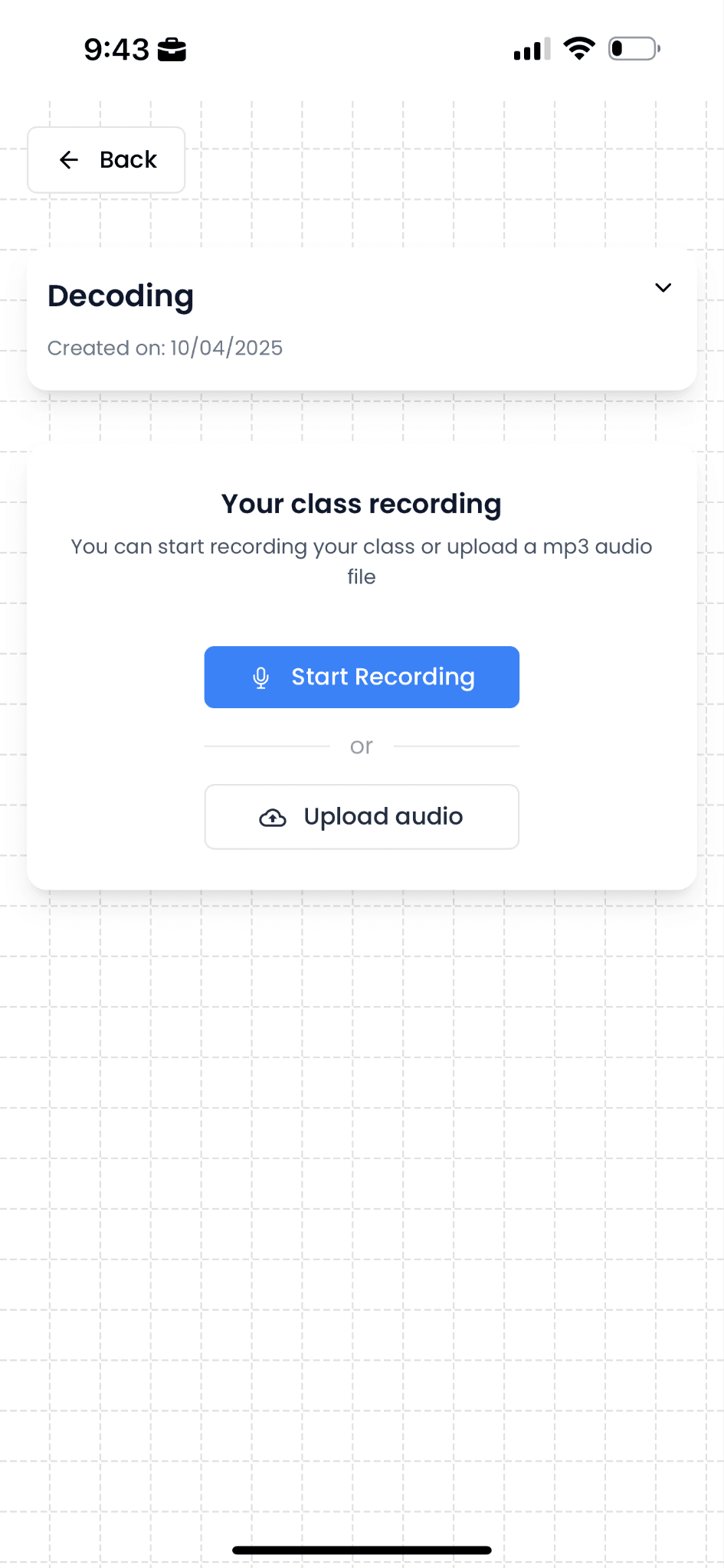
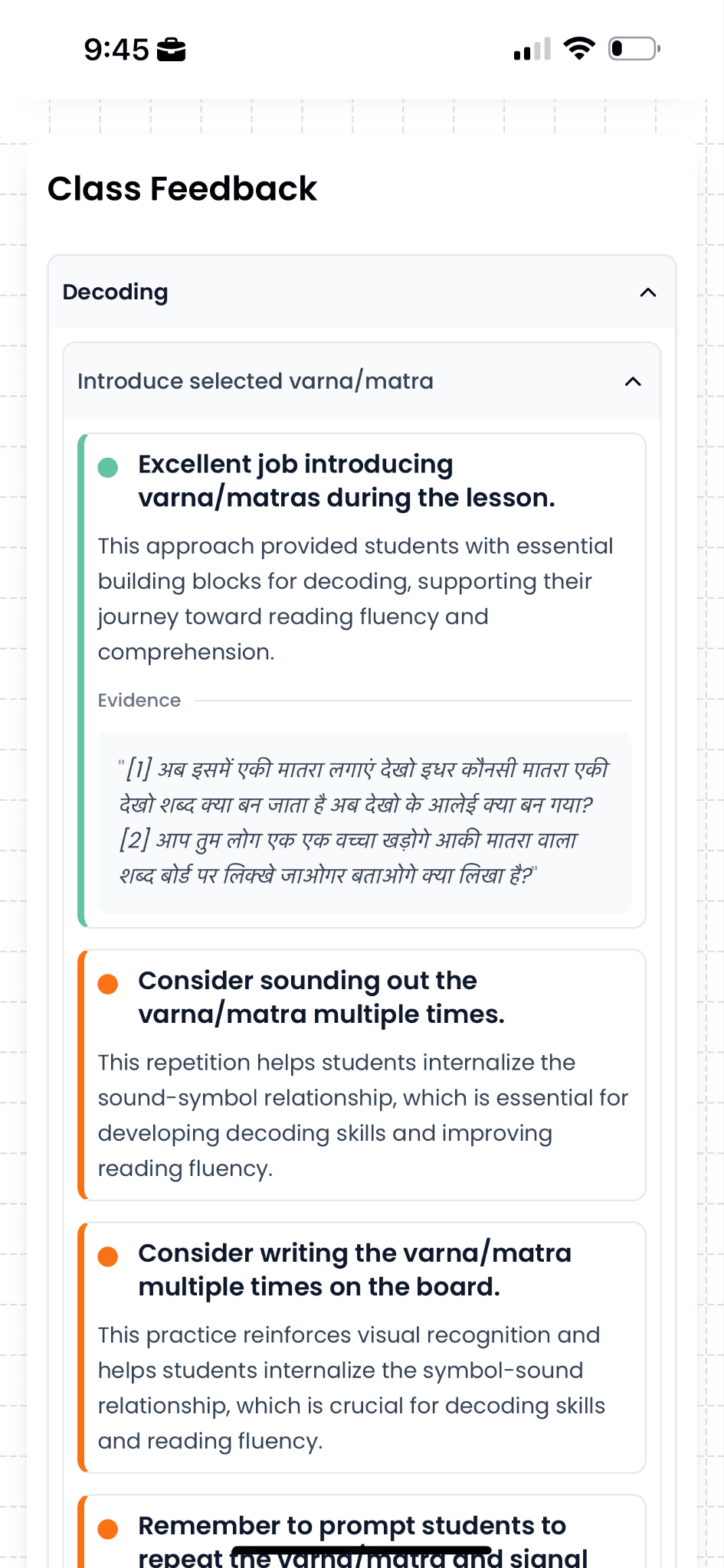
The report describes the lesson and never grades the teacher, because a score would have turned the coach into one more inspector. It opens with up to three things that went well and up to three to work on, each gap linked to a short how-to video made with CSF's pedagogy team. Below that, every step is marked done or not done, and a step marked done plays the moment from her own recording that shows it. The two screens at the top of this page are from the second test.
Stage gates
Each phase had to earn the next one
I planned four phases, each with its own definition of success: a small first proof of concept (do teachers use it, and is the model accurate enough?), a second with field visits (where do they get stuck?), a 50-teacher pilot (does teaching change?), and a second pilot of 150 or more teachers, designed to compare three ways of running the coach.
The first proof of concept taught us most in the schools that most need a coach. In remote schools with no signal, a recording could not upload and no feedback came back. So the pilot app records offline, keeps the audio on the phone, and sends it when the teacher is back online.
In the second, with 12 teachers, I went to schools with the team, wrote the observation and interview guides, and ran live usability sessions. All 12 needed help to start and stop a recording, and 11 needed help to create a class, so those screens were redone first. 10 of the 12 said the feedback was more useful than a mentor's visit, because it was detailed and did not judge them. I also set up event tracking, click heatmaps and session recordings, so we could see which screen stopped a teacher and fix it before the pilot.
Results
Both pilot targets met; key steps rose from 53% to 74%
The pilot ran for eight weeks with 50 government school teachers in one district. Teachers recorded about one lesson a week, each about 14 minutes long. Before it started, I had set its pass marks: at least 30% of teachers using more key steps from first recording to last, and at least 60% completing six or more feedback cycles.
Exhibit 3
Both targets were met, and key teaching steps used rose
| What | Result | Status |
|---|---|---|
| Key teaching steps used, first recording to last | 53% to 74% | Measured |
| Teachers who showed overall improvement (target 30% or more) | 37 of 50 (74%) | Met |
| Teachers with six or more recordings (target 60% or more) | 34 of 50 (68%) | Met |
| Found the feedback accurate and helpful | 87%, number answering not published | Self-report |
Next
The next test adds a comparison group and human scoring
The next pilot would include a randomly chosen group of teachers who do not use the coach. Comparing the two groups shows how much of the change the coach accounts for.
People would also score a sample of recordings, step by step, alongside the model. That checks the coach's own count of steps used, and shows whether the trade made in the key decision needs retuning.
The second pilot I planned, for 150 or more teachers, then compares three ways of running the coach, such as teachers using it alone against teachers with a mentor's support. Both of the biggest changes to the coach so far came from watching teachers use it in their own schools, so I would keep visiting schools in every phase.
Sources: IndiaAI casebook 2026, case study 29, pp. 57-58; CSF model evaluation and research framework sheets, February to May 2025; CSF updates to the funder, April and May 2025; the partner's project notes, 2025.