The problem
A reading test needs one adult per child
The usual test of early reading has a child read a passage aloud for a minute while an adult marks each word she gets wrong. The result is correct words per minute, the most common measure of reading fluency. In 2022, at my previous job, I built the digital version of one state's sample test of Grade 3 children. One test of one grade still needed over a thousand trained adults listening to children one at a time.
Speech AI, a model that hears which words a child said and checks each against the passage, can do the listening. In this tool, a teacher records a child reading in the state's own app and the score comes back by itself.
My part
My part was expansion, and five new states signed
I was a Senior Program Officer in education at Wadhwani AI from September 2025 to July 2026. The tool already ran across two whole states. A program owner led it, product, engineering, machine learning, pedagogy and evaluation teams built it, and state program officers ran each state.
My work was taking it to new states. I planned the school sample for one new state's voice recordings, 300 schools across Grades 1 to 5, and worked on the final round of that state's agreement before it was signed in November 2025. In July 2026 I presented the program's reach and plans at a sector consultation.
Rollout calls
Four team calls traded polish for faster adoption
A signed agreement with a state lets work start. Before children are assessed, the team needs recordings of children reading in that language, a model tuned on them, a pilot and teacher training: about six to eight months. These were the team's calls, and I worked within them:
| The call | What it gave up | Why |
|---|---|---|
| Reach teachers inside the state's own app, chatbot or a no-install link | One standard app of our own | Teachers already use the state's app, and it outlasts any one grant |
| One connection point for a state's software, not two | A cleaner design on our side | One state's integration could take only one call |
| Launch a language before the model covers every letter | Full coverage at launch | Children are assessed months sooner |
| A checklist of gates before each state goes live | Speed | Data, model, group rules and training each pass a gate with a named owner |
The third call came with a rule for passages. In one new language the training data reliably covered 108 of more than 400 letters, so passages must avoid the rest. That keeps a child from being marked wrong for a letter the model cannot yet score.
The tool
AI scores every word; rules place each child in a group
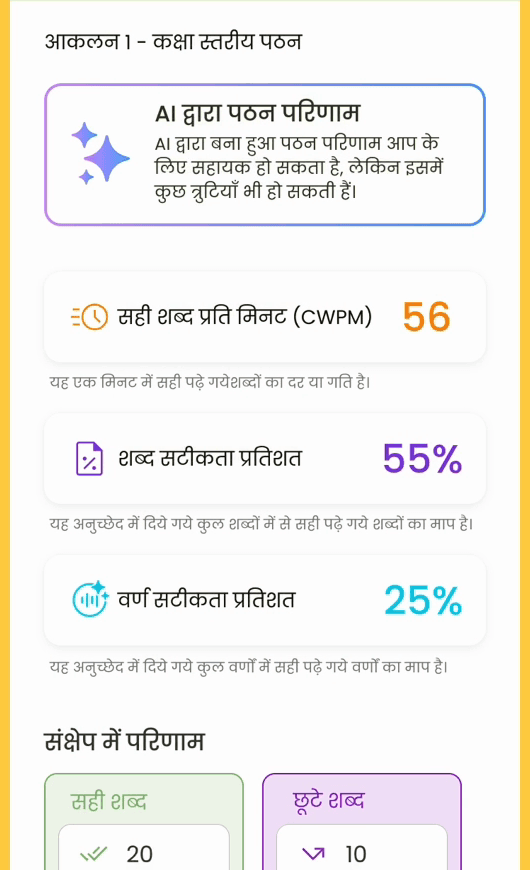
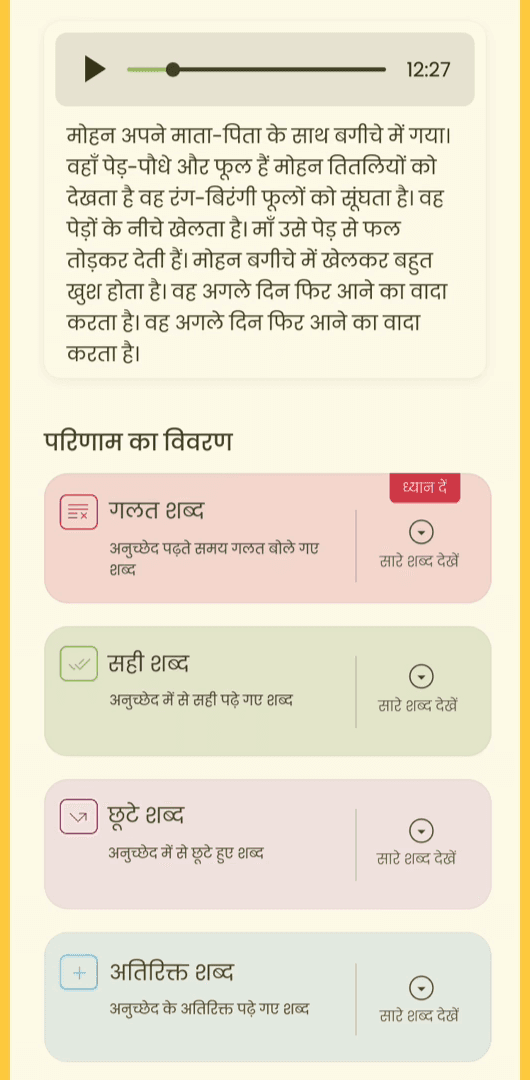
A child reads, speech AI scores every word, and simple rules on fluency and accuracy place the child in one of four reading groups. A model meant to find the groups ran late, so experts set score ranges and each state vetted them. Practice for each group is the next piece, in design in July 2026. The result screens a teacher sees are at the top of this page.
Teachers believed the scores, and field visits showed what they needed next. Some said they did not use the results "because we don't know their purpose." Practice for each group is meant to give the score that purpose. A November 2025 field check also traced mismatched scores to how recordings were made: 12 of 30 recordings did not match the child, all from 2 of 4 schools where teachers recorded in batches. Flagging an adult's voice, and two children's voices in one recording, went onto the product plan.
Results
Two states assessed more than 9 million children; five more signed
| Measure | Number | Status |
|---|---|---|
| Children assessed, two states, 2023 to June 2026 (program reach) | More than 9 million | Measured |
| Assessments, same period | About 35 million | Measured |
| Assessments in my time, October 2025 to June 2026 | About 21 million | Measured |
| New states that signed agreements in my time | 5, plus 1 letter of intent | Signed |
| New states piloting by July 2026 | 1 of 6, about 1,400 students | Piloted |
| Teachers in one state who intend to keep using it | About 8 in 10, of 834 | Self-report |
A child can be assessed several times, so assessments outnumber children. The first three rows are the reach of the program and the two states. The next two are the expansion I worked on, alongside state program officers.
Next
What I would measure next
A before-and-after study of about 2,200 students in about 40 schools was approved in late 2025. To fill Before-and-after study results by reading group, if they exist and can be shared
I would publish one table per state: for each reading group, the share of children who moved up a group between two tests, with the number of children and the dates. I would add a comparison group to the next study, so that movement can be set against schools without the tool. And I would put reading groups and practice for each group into every state's first agreement, with a way to count whether teachers used them.
Sources: Program deck, July 2026, with figures to 25 June 2026; program assessment sheets and funder reporting, July 2026; agreements sheet; perception study in one state; field check, November 2025; product plan, 2026.